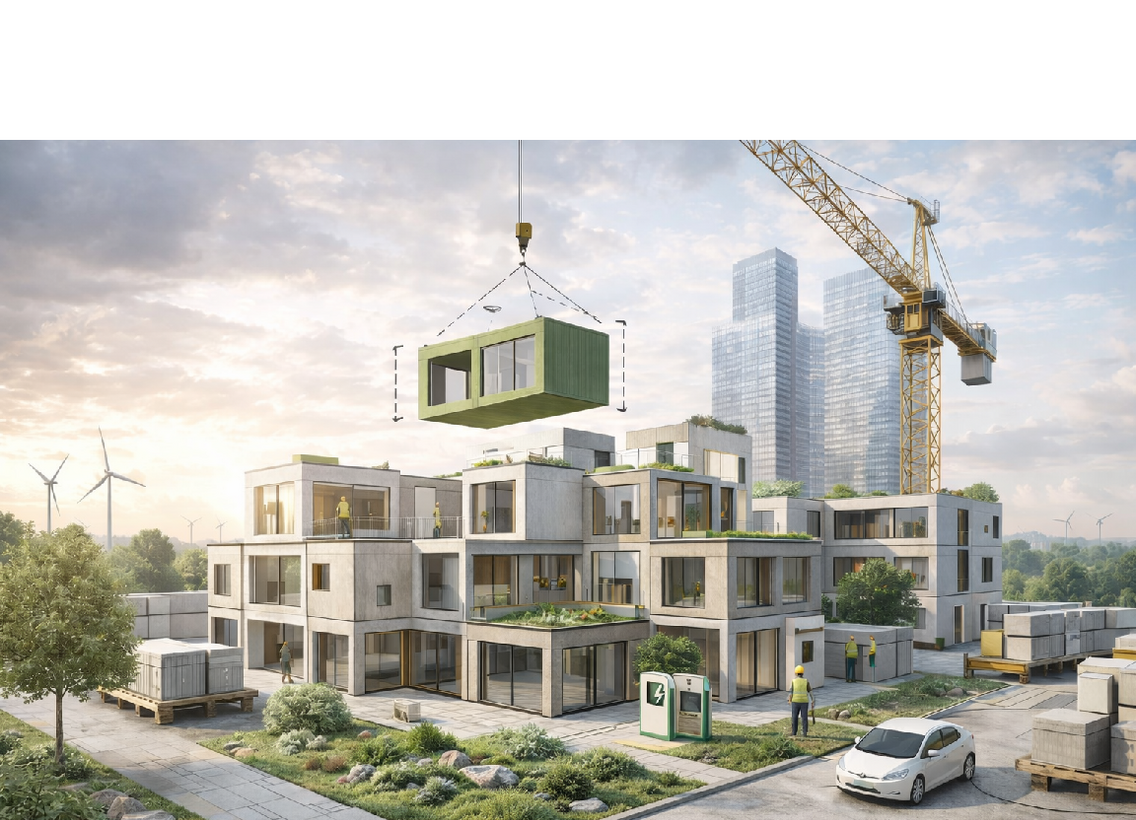
Definition of Serial, Modular, and Systemic Construction Methods (SMS Construction Methods)
Serial, modular, and systemic construction methods (SMS construction methods) fundamentally refer to approaches in which large-scale wall, ceiling, floor, roof, and facade elements, or space-enclosing modules and volumetric units, are factory-prefabricated and subsequently assembled or installed on-site. Prefabrication is characterized by standardized, (partially) automated, and/or serial (repeatable) manufacturing steps that are subject to quality assurance. It typically takes place across multiple trades. These construction methods are grounded in digitized, integrated planning and manufacturing processes. In new construction as well as the extension and refurbishment of existing buildings—taking ambient and environmental conditions into account—they unlock potential for efficiency, quality, sustainability, and cost optimization.
Source: Round Table on "Serial, Modular, and Systemic Construction", Federal Foundation Bauakademie
“In the context of strained housing markets, serial, modular, and systemic construction demonstrates that accelerated building processes are compatible with high architectural quality–while distinctly setting themselves apart from the monotony of historical serial building methods.”-Guido Spars
Approaches and Concepts
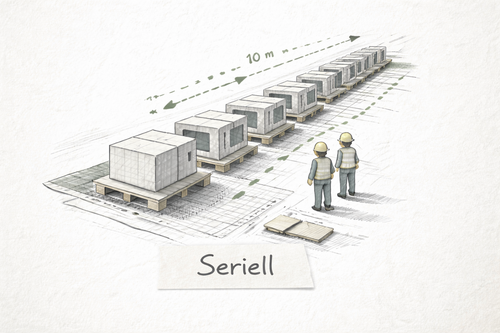
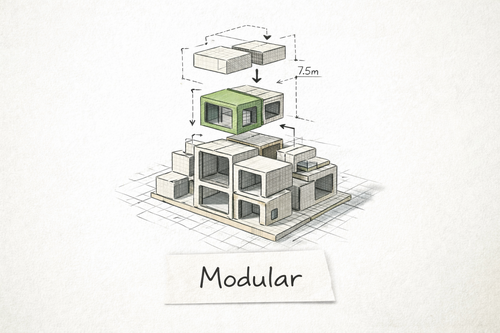
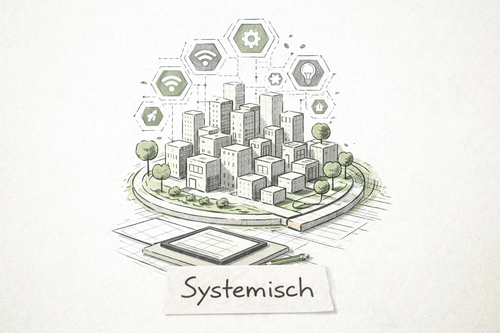
Future-oriented construction
Future-oriented construction combines ecological, economic, and social sustainability with technological innovation. In the context of serial, modular, and systemic construction, this means utilizing digitalization, the circular economy, and industrial processes in such a way that durable, adaptable, and socially responsible structures are created. Current research examines how these principles can be effectively implemented under varying global framework conditions.
The Round Table on Serial, Modular, and Systemic Construction was established by the BMWSB under the leadership of Prof. Guido Spars, founding director of the Bundesstiftung Bauakademie (2021–2025), to bring key stakeholders from academia, the construction industry, planning, administration, and politics into a structured and target-oriented dialogue. The objective is to analyze the potential of industrial and systemic construction in Germany and translate it into concrete measures to promote these construction methods and overcome barriers.
Operating at the Bundesstiftung Bauakademie since September 2023, the Round Table functions as an interdisciplinary platform where technical innovations, organizational structures, and regulatory frameworks are discussed collaboratively. The central focus is on how the German construction industry, research community, policymakers, and public administration can overcome the numerous obstacles that have hindered the broader application of these building technologies to date.
Particular attention is given to:
- eliminating legal and administrative obstacles (e.g., procurement law, approval, and permitting procedures),
- financial support for serial, modular, and systemic construction methods (e.g., subsidy programs),
- increasing demand for SMS buildings and overcoming prejudices against these construction methods,
- developing best practice examples for affordable housing using SMS construction methods,
- establishing common quality and sustainability standards for serial and modular construction methods,
- digitalizing value chains in the construction sector (including through BIM and automated manufacturing processes),
- promoting the circular economy and resource efficiency,
- as well as strengthening initial and ongoing education and training to build competencies for new forms of planning and production.
Through the close integration of research and practice, the Round Table contributes to laying the groundwork for a new building culture of industrial construction—one that regards sustainability, cost-effectiveness, and architectural quality as equivalent goals. The outcomes of this work feed directly into ongoing research projects at universities, political decision-making processes, and construction industry initiatives.
Prof. Dr. Guido Spars in BPD Magazine: Potentials of Serial and Modular Construction
In the May 2026 issue of BPD Magazine (page 83), Prof. Dr. Guido Spars discusses the potentials of serial and modular construction and contextualizes their significance for current challenges in residential construction. The focus is placed particularly on the question of how new construction methods can contribute to greater efficiency and affordability in housing construction.
Serial modular construction – can it create affordable housing?
In an interview with Deutschlandfunk Kultur, Prof. Dr. Guido Spars discusses the potential of serial and modular construction for creating affordable housing. The interview was published on June 19, 2026, and has a running time of 7:44 minutes.
→ To the interview at Deutschlandfunk Kultur
Specialist Article on the Promotion of Serial, Modular, and Systemic Construction Methods
Spars, G.; Neitzel, M.: Serial, Modular, and Systemic Construction (SMSB) – Impulses for Housing Construction in Germany.
The article contextualizes serial, modular, and systemic construction methods within current challenges in residential construction and sheds light on key framework conditions, potentials, and barriers. In particular, it discusses the role of the Round Table as well as the contribution of these construction methods to acceleration and quality assurance in the building process.
Specialist Literature on the Subject
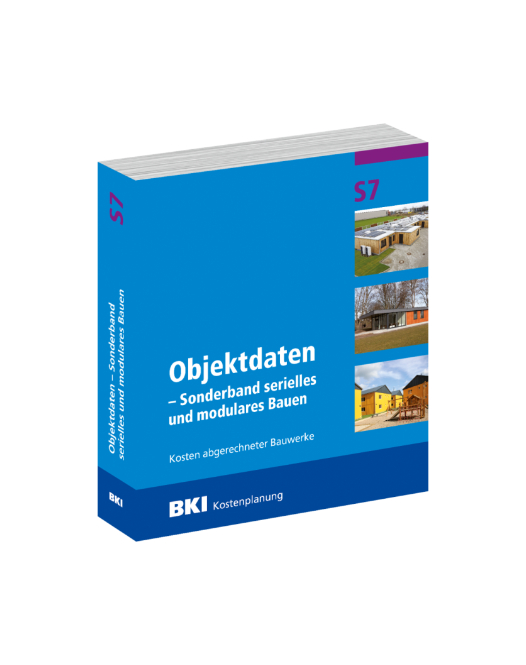
Special volume S7 "BKI Objektdaten" provides a reliable database for evaluating construction projects in the context of serial, modular, and systemic building methods.
It is available at the Chair of Economics of Planning and Building and can be consulted by appointment.
Contact
Univ.-Prof. Dr.-Ing. habil. Guido Spars
Teaching and Research Area
Economics of Planning and Building
Pauluskirchstraße 7
42285 Wuppertal
Tel. +49 202 439 - 4323
Fax: +49 202 439 - 4035
E-Mail: spars[at]uni-wuppertal.de
Online Profiles